When we educate ourselves and our children or family and friends, it has to do with: Listening carefully and rationalizing the words before saying them, searching in our conscience what is missing and what is left over, what we feel good and what bad in order to modify them before talking, according to purpose and accord when teaching and transmitting for the better or worse of the other and/or the majority. To modify, it is necessary to adopt creative and constructive knowledge following the norms and laws of the territory, values, regulations and human and creator principles, using reasoning with common sense and empathy. The formation of the thinking of the common people and professionals of the future depends on what we teach today...(R.O.L)
Exactly, We are training them to alienate them or employ them in jobs of the future or robots. It is clear that we are not preparing for anything that is coming. And the mistake we are making is that we put a lot of that blame on the teachers. What I think we should do is ask the right questios, turn ourselves and the teacher into one of the people with the most knowledge about what is required in the present and future society (what we want to convert our family, country, world, by asking everyone inhabitants and representatives, holding general votes on the issues would be an alternative, asking for example: we want a perfect society...lets start by defining perfect among all...another proposal could be, we want a society without crime...define what they are. the crimes that you want to eradicate...etc.) together with general knowledge plus values ??and principles of each individual. Because in the end we and they are the ones who will shape thinking, creativity, social cohesion, the sensible ones will strengthen the foundations that lead to creating a strong and sustainable economy, responsible and harmonious with the whole.
We could give them autonomy and strengthen their professionalism with our collective instructions and rules to obtain the required result, and offer parents tools of general knowledge of human values ??and principles instead of blaming them because the younger generations do not measure up and do not even know know yourself to make creative, conscious and constructive choices.
In that sense, what skills should teachers teach in classrooms to face the future?
I think children require three things. The first is to learn to think with knowledge (objective, tolerable, basic and common), rationalize, discern and differentiate, choose, but in a way according to the challenges of the future. They could be taught to think critically about the world, about the role they want to play based on a deep knowledge of themselves.
The second thing is to learn to act, but especially how to be creative. Now we are facing immense challenges in environmental issues (it is good to make robots to clean the planet), the increase in inequality, a scenario where current jobs will be replaced by machines... So there we are going to need children to thoroughly develop their creativity and willingness to learn what is required.
And that means that children must not only learn to be creative, but also to work, with the help of new technologies, together with other people.
And third, apply that creativity in solving problems facing the modern world. To take care of themselves and the people around them.
As society becomes increasingly polarized, students need to develop their emotional intelligence to be able to connect and empathize with other people, whether in their community or globally.
But above all, they learn to understand their own emotional development, so that they are able to manage their well-being in a world in which it is more difficult to live every day, especially when you have no idea of ??the purpose of physical life.
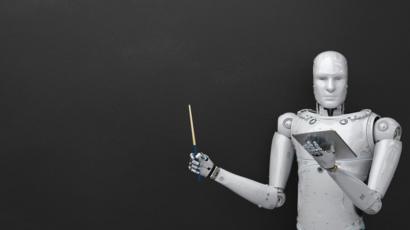
Derechos de autor de la imagenGETTY IMAGESImage captionWill teachers be replaced by robots? Beard believes that will not be the case.There is a theme that is present in his book "New Ways of Learning", the role of education in helping to find "meaning in the things we are doing."
One of the things that is transforming the way we understand education is research into how our brain works, in the fields of psychology, early development and even neuroscience.
And one of the things that cognitive scientists have found is that there is a hierarchy to our experiences whose results lead us to learn. If we insist on repeating and memorizing, then you are going to retain a certain amount of knowledge and you are going to learn to some extent. In the authors concept it is good to consider that what is learned in the physical state is received and memorized by the conscious energy of each person.
But if the things you are learning cause an emotional reaction in you - that is, they make you feel excited, sad, confused, shake you, and so on - you may retain more knowledge than through memorization.
Getty Images
Las escuelas hoy en día no saben con claridad en qué deben enfocarse, en qué deben centrarse teniendo en cuenta el futuro"
